How To Read anEyeglasses Prescription?
All you need to know about the terms used in your eye prescription.
Eye tests are crucial to ensure your vision is at its best. But reading eye prescriptions is something that confuses even the smartest minds. Before we start decoding your eye prescription, you can get a free eye test appointment at the Specscart store to get a precise prescription.
However, reading an eye prescription can be puzzling for many people. Let’s simplify the puzzle: “How to read a prescription?”
How to Read an Optical Prescription
Here is a video to help you understand your prescription with the relevant visuals. We have simplified all the terms for your easy understanding of the complex terms used in your eye prescription.
Sphere (SPH)
The SPH denotes the power of your glasses. It can tell you if you're short-sighted (“-” negative sign before the power, difficulty seeing distant objects) or long-sighted (“+” positive sign before the power, difficulty seeing closer objects).
Eyeglasses Prescription
John Dew
DD/MM/YYYY
R
L
SPH
+1.75
+1.00
CLY
-
-
AXIS
-
-
PRISM
-
-
ADD
-
-
Pupil Distance:
Cylinder (CYL)
The cylinder in your prescription refers to astigmatism, a common irregularity in the shape of the eye. It measures the degree of this irregularity. Think of your eyes as ideally spherical, like a basketball. However, many eyes are more like a rugby ball, slightly oval-shaped. The cylinder value indicates how much this shape deviates from being perfectly round.
A higher cylinder value suggests your eyes are more oval-shaped, affecting your vision. If there's a '0' or nothing mentioned in this section, your eyes have a near-perfect spherical shape.
Eyeglasses Prescription
John Dew
DD/MM/YYYY
R
L
SPH
-
-
CLY
-0.25
+0.75
AXIS
-
-
PRISM
-
-
ADD
-
-
Pupil Distance:
Axis
The axis complements the cylinder and denotes the orientation or angle of the irregularity caused by astigmatism. It's measured in degrees from 0 to 180 and specifies the exact location of this imperfection in your eyes. This helps the optician precisely correct your vision.
Eyeglasses Prescription
John Dew
DD/MM/YYYY
R
L
SPH
-
-
CLY
-
-
AXIS
80°
110°
PRISM
-
-
ADD
-
-
Pupil Distance:
Prism
The prism in your prescription corrects eye alignment issues, such as double vision due to eye misalignment. The prism power, direction (BU = base up; BD = base down; BI = base in; BO = base out), and strength help in aligning your eyes to eliminate visual disturbances.
Eyeglasses Prescription
John Dew
DD/MM/YYYY
R
L
SPH
-
-
CLY
-
-
AXIS
-
-
PRISM
1 Out
1 Out
ADD
-
-
Pupil Distance:
Add
The 'Add' refers to additional power, mainly for reading, often associated with age-related long-sightedness (presbyopia). As we age, it becomes harder to focus on close-up objects. This positive number represents the strength of additional power required for clear near vision.
Eyeglasses Prescription
John Dew
DD/MM/YYYY
R
L
SPH
-
-
CLY
-
-
AXIS
-
-
PRISM
-
-
ADD
+2.00
+2.00
Pupil Distance:
Pupillary Distance (PD)
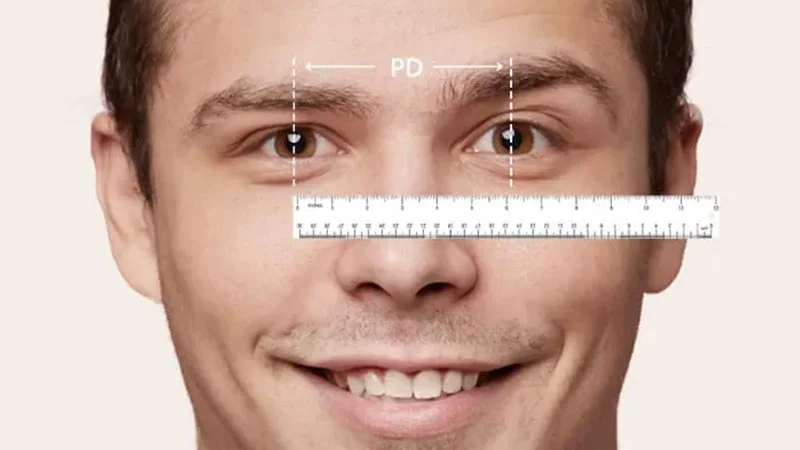
Your pupillary distance (PD) is the measurement between the centres of your pupils. This measurement is crucial for placing the optical centres of your lenses correctly. While it is often measured by an optician, in some cases, you might need to measure it yourself to ensure the best vision experience with your glasses.
Eyeglasses Prescription
John Dew
DD/MM/YYYY
R
L
SPH
-
-
CLY
-
-
AXIS
-
-
PRISM
-
-
ADD
-
-
Pupil Distance: 63
Distance between your Pupils
Understanding the Eye Prescription Scale
When you look at your eye prescription, the numbers you see represent the amount of lens power needed to correct your vision. These numbers move along a scale that can go into negatives or positives, depending on whether you are nearsighted or farsighted. A prescription of 0.00 means your vision doesn’t require correction.
Minus Values (–): Nearsightedness / Myopia A negative sign before the number shows that you are nearsighted, which means you see nearby objects clearly, but distant ones appear blurry. The more negative the number, the stronger the correction required. For instance, –3.00 indicates a higher level of myopia compared to –1.00.
Plus Values (+): Farsightedness / Hyperopia A positive sign means you are farsighted, which is the opposite. Close-up objects may be difficult to focus on, while distant vision is clearer. The larger the positive number, the greater the correction for hyperopia. For example, +4.00 suggests stronger farsightedness than +1.00.
Zero (0.00): Clear Vision A prescription of zero indicates that you do not need corrective lenses for distance or near vision.

Free Eye Test for Everyone
When was the last time you had your eyes tested? If you’re scratching your head trying to remember, it might just be the perfect moment to pop in. We offer free eye test for everyone at our stores in Manchester. Book an appointment at your nearest Specscart store today and enjoy a comprehensive eye test, completely free.

People's Champion
400,000+Happy Eyes Worldwide

WOW just outstanding service
January 31, 2026

Great service
January 28, 2026
Excellent company to deal with
January 27, 2026




Still Unsure About Your Prescription?
No worries, we’re here to help. Just drop us an email with your prescription, and our team will happily guide you through it. From understanding the numbers to finding the perfect pair of glasses, we’ll make the whole process simple and stress-free.
FAQs
What is CYL in an eye prescription?
CYL or cylinder in your eyes shows irregularity in the shape of your eyes, which is also known as astigmatism.
What is SPH in an eye prescription?
SPH in your eye prescription refers to the power that is required to correct your vision. If it is a negative number, it means you are short-sighted, and if it’s a positive number, it means you are long-sighted.
What is the legal blindness prescription?
In the UK, legal blindness is defined as visual acuity of 3/60 or worse in the better eye with best correction, or a visual field of less than 10 degrees around central fixation. This isn't based on a glasses prescription number but on how well you can see even with corrective lenses.
What is a normal axis for the eyes?
The eye axis refers to the location of astigmatism on the cornea, measured between 0 and 180 degrees. A 'normal' eye axis typically indicates no significant astigmatism or a minimal level below 0.50 diopters. Astigmatism above 1.5 diopters usually requires corrective eyewear, while a measurement of zero diopters suggests the absence of this refractive error.
What do OD and OS stand for in an eye prescription?
OD is an abbreviation for oculus dexter in Latin, which means your right eye. While OS stands for Oculus Sinister in Latin, which means your left eye. The number beside these sections represents the correction required for the vision of that particular eye.
What does BVD mean in eye prescription?
"BVD" in an eye prescription stands for "Back Vertex Distance," indicating the space between the back of corrective lenses and the eye's cornea or spectacle plane. It’s usually mentioned in high-strength prescriptions.